

The year that I planted our first garden, I was a pregnant mom of two toddlers.
I could barely bend low enough to tend our two raised beds with a trowel. We watched the garden grow large as I grew round, both of us spilling over to bring forth new life. The littles ones braved the unwieldy jungle to retrieve hidden tomatoes and monster zucchini. Our harvest that spring was so abundant and delightful that no one could have guessed its dark and melancholy origins.
Shortly before our son’s first birthday, I found myself taking a pregnancy test. At first, it appeared negative. I set it on the counter to attend to the regular rhythm of chaos that hummed throughout our 1200-square-foot house. Built in 1960, our fixer-upper kept our weekends occupied with home improvement projects, but we adored it for its spacious, tree-lined backyard that made it feel like our own private oasis—a rarity in Southern California suburbia where even small houses loom large on lots the size of a postage stamp.
And so, we embraced the pitter-patter of little feet on the laminate flooring that slanted across the uneven foundation, drywall cracking in the corners with the contraction and expansion of the California clay. Later that morning, chaos diffused, and I returned to check on the pregnancy test I’d abandoned on the counter. Before I’d even crossed the threshold, its bright pink line jumped out at me from across the bathroom, instantly producing waves of shock and joy in equal measure.
Delighted as we were to be expecting our third baby, I soon found myself unable to access that joy. As if someone had turned off the water to a faucet, my emotions ran dry. I no longer felt delight, anticipation, motivation, or even contented satisfaction. In their place came inexplicable, sourceless darkness and despair. It was all I could do to drag myself through the most basic motions of stay-at-home motherhood.
About a year had passed since I’d left my full-time teaching job to stay home with my kids a few months after completing my master’s degree in bioethics. I had just begun a writing stint for a publication of which I had all but begged to be a part. Dream after dream was coming true, but now it felt as though someone else had dreamed them. Confused and ashamed, I had to ask my editor for a leave-of-absence. I could no longer put words on the page. It stayed blank, just like my insides.
I now know that this was the first sign of my burgeoning battle with chronic disease. It would be years before I would put it together that my bouts with prenatal depression in this and the following pregnancy, my bone-deep exhaustion, hair loss, difficulty losing weight, and searing joint pain were all connected.
For many women with autoimmune disorders, their symptoms take a back seat during pregnancy. I don’t know if it is me or the Hashimoto’s, but my symptoms flare up worse than ever. There is something about growing new life that makes me feel like I am dying. All I knew at the time was that my life—a life that had once been full of joy and possibility—was suddenly bleak and gray. Nothing had changed, but everything was different. That’s when I found her.
She was this incredibly vibrant woman, not much older than me, with a few more kids and a velvety smooth voice. I stumbled across her YouTube channel, and immediately I was hooked. Every inch of her was as lovely as the flowers that sprawled across her cottage gardens. I was drawn in by the aesthetic appeal of her videos, but even more enchanted by the beauty of her words and enticed by the lifestyle she espoused. She spun tales about life on the homestead that quickly became my own grown-up fairy tales.
From the stunning flowers blooming on the borders of her stone steps to the ripe, juicy tomatoes she sliced on her well-worn wooden cutting board to the luscious grapes hanging heavy from the vines spilling over her courtyard arbor, I devoured every second. As I binged her videos, I absorbed her philosophy and let it take hold until it became my own. My soul soaked it all in, and, like a dried out old sponge, sprang back into life. By my second trimester, we were building raised garden beds and filling them with compost.
I give thanks for my initial ignorance; if I had known from the beginning what a vast undertaking it is to grow your own food, I am not sure I would have persisted. Years of schooling may have earned me two master’s degrees, but I knew next to nothing about how our food is grown or where it comes from. Blissfully ignorant, I plopped down with a couple of classic gardening books and calculated how much space we would need for our small but growing family.
I quickly learned that you cannot, in fact, grow all your own vegetables in two raised garden beds, and that even if you fill your yard with fruit trees, it will be years before you actually taste the fruits of those labors. As we prepared to relocate to Idaho’s Snake River Valley, my homestead dreams quickly took a back seat. We packed up boxes. Our fourth baby was born. I published my first book.
Six years later, we find ourselves a thousand miles away—literally and figuratively—from where we were in those early gardening days. We moved to a one-third-acre property in a typical suburban neighborhood that backs up to an irrigation canal that borders the remnants of rural Idaho. My writing desk on the second floor overlooks twenty acres of open field, home to prancing peacocks, millions of chirping crickets, and soaring birds of prey. Our neighbors raise their own cows, horses, and chickens. We may live in suburbia, but if you close your eyes, you’ll find yourself immersed in the sounds and scents of the country.
We dove into homeschooling and settled into our new parish community. We built relationships with some of the best neighbors around. We eagerly awaited fruit from the small orchard we’d planted the first year we moved in, and we munched on peas, lettuces, strawberries, tomatoes, cucumbers, and zucchini from the five raised beds we built that first year. The garden was buzzing, but the dream of growing enough food to feed our family was dormant, sealed away in one of our unpacked boxes. Then one day, I stumbled upon it hiding in the weeds behind our fence.
The garden was buzzing, but the dream of growing enough food to feed our family was dormant, sealed away in one of our unpacked boxes. Then one day, I stumbled upon it hiding in the weeds behind our fence.
Our home borders one of the many canals in the valley’s intricate irrigation system. Our property line runs down its center. Our backyard fence stops quite short of that due to an easement next to the canal that allows for easy access when it needs to be serviced. The area between our fence and the canal was a weedy patch of puncture vine, bindweed, and tall grasses. The brush was almost too thick to walk through, but the occasional venturesome dog walker would find his way through.
That day, my heart sank as I discovered the remains of nocturnal teenage revelry in the form of piles of trash littered about our property. I thought back to my days studying Malcom Gladwell’s The Tipping Point, in which he describes how New York officials cut crime by eliminating signs of disorder, like cleaning up graffiti on the subways. As disappointed as I was, could I really blame those kids for treating our property like a dumpster? It looked utterly abandoned, certainly not as though it mattered to anyone.
As quickly as if I’d dropped a match into those dried up weeds at my feet, the spark of an idea engulfed my consciousness. “What if this space became a garden?” I asked myself. If this were a well-tended place of beauty, not only would our kids’ bare feet have fewer wounds from puncture-vine thorns and neighbors receive the signal that this land belongs to somebody, but we could also reclaim this soil—our soil—as a place of productivity and nourishment for our family. I had lost any illusion that we could grow everything we needed in those two small garden boxes long ago, but continued to pack away my thoughts of what ifs and somedays tenderly, sealing them in a box marked for a future property on sprawling acreage, a property with towering barns and open fields signaling the potential for self-sufficiency.
But as I surveyed the weedy patch of dirt and plucked trash out of the dust, those dreams burst out of the box where I had sealed them and settled in the soil before me. Words echoed unbidden through my mind. First, the words attributed to St. Teresa of Calcutta: “Grow where you are planted”; followed by those from the Gospel of Luke: “Whoever is faithful in a very little is faithful also in much” (16:10). From that moment on, those escaped dreams took on the character of a call, a call that rooted itself in our soil, on our land. Those words opened my eyes both to the dignity of our land and to the faithfulness with which I was called to steward it. How could I truly say I dreamed of living off the land when I hadn’t yet been faithful to the land beneath my feet?
That day, I got to work. I laid down cardboard and hauled in yards of compost and mulch, employing the “no-dig” approach I’d seen in dozens of gardening videos. The land sloped down from our fence toward the canal. I evened it out by applying thicker layers toward the lower end. Later, I purchased compost and mulch in bulk and shoveled it into our wheelbarrow to apply it to the garden plot. It took me weeks in the whipping spring wind.
When at last I finished and surveyed twelve garden beds of dark earth neatly demarcated by wood chip paths, my husband cheerily observed that they looked like freshly dug graves. In a way, they were. My lofty, starry-eyed homestead dream was dead and buried; my new mission to grow where we are planted was born.
Slowly, I discovered that we could do so much more on our little piece of land than I had realized. Every inch of our property took on a new air of possibility. We devoted a section of our yard to chickens and used their spent bedding for compost and to fertilize the raspberries. That first year, we grew enough onions, potatoes, and squash to last us through the winter.
The next year, we added a year’s supply of garlic, dried herbs, and herbal teas. I canned jam from our blackberries, and we canned a hundred pounds of peaches from a local orchard. The kids spent their summer stuffing their faces with strawberries, and we welcomed bees, butterflies, and hummingbirds as they hovered above jewel-toned zinnias towering over the children. We have become stewards of abundance—not just of food, but of beauty and joy, simplicity and wonder. Even with all this fruitfulness, we have yet to maximize the harvest potential we have on our one-third-acre suburban property.
With abundance comes work. Gardens need tending, weeding, and a vigilant sentry to keep squash bugs at bay. Simply receiving the bounty requires diligence in cultivating, harvesting, and preserving. Everything from the unpredictability of the weather to unexpected pests guarantee that the gardener bathes daily in the sometimes gentle and sometimes torrential waters of humility. With every seed sown and fruit harvested, I was encountering the Holy Spirit in the gentle breeze of the garden. In the creeping weeds, I saw our need to pull sin out by its roots. Drought spoke to me of meaning in spiritual dryness.
I am hardly the first gardener to be enchanted by God’s presence in growing things. Scripture is filled with agricultural metaphors, as are Jesus’ parables. As I write to you, it is Holy Week, and I am reminded that some of the most significant moments of Jesus’ life—and the Father’s plan for our salvation—took place in gardens: the agony in the garden of Good Friday, and the Resurrection of Easter Sunday. If we look further back, we recall that God’s gift of original holiness was set in a garden. It was there that we fell by Adam’s “happy fault,” catapulting us into the greatest story of love and redemption that will ever be. We may not all be called to off-grid homesteading or large-scale market farming, but we are all made for the Garden.
We may not all be called to off-grid homesteading or large-scale market farming, but we are all made for the Garden.
This journey to increase our self-sufficiency has given our family a vision not born of fear or scarcity but rooted in the call to joyful stewardship. What began as a response to chronic illness grew into a celebration of abundance—a way of life that nurtures the body and soul alike. Rather than retreating into rugged individualism, this lifestyle is an invitation into deeper interconnectedness: with creation, with each other, and most of all with Christ. It is a Christ-rooted, family-centered, seasonally oriented approach to living—one that honors both the limits and the gifts of our days.
I hope and pray that this book nourishes both you and your garden, helping you to deepen your roots and bear good fruit, and always, to grow where you are planted!
This reflection is adapted from my new book, Grow Where You’re Planted: Reclaiming Eden in Your Own Backyard, releasing March 17, 2026!
Grow Where You’re Planted Cover Reveal

A prayerful and practical guide to cultivating seasonal abunance and sustainable family life, this book provides so much value, including:
step-by-step instructions for cultivating a garden from scratch
a month-by month chore guide for cultivating the garden
annual seed inventory
seasonally-inspired garden-to-table recipes the whole family will love
tips for raising little gardeners (plus a downloadable year-long, hands-on, lit-based elementary science curriculum expansion rooted in nature, the garden, and the seasons)
“seeds for contemplation” reflections for growing in the garden of our souls
If you’ve ever felt God move in the garden or wondered if you could grow your own food in your own backyard, Grow Where You’re Planted is for you!
Gorgeous and Giftable
The team worked so hard to make the interior beautiful, and it shows. The layouts are gorgeous and the design is delightful.
A hard cover with full-color interior, the book makes a perfect gift for the gardener in your life. Each season includes both devotional reflections and practical how-tos.
I can’t resist sharing some screenshots from the most recent proof they sent me:
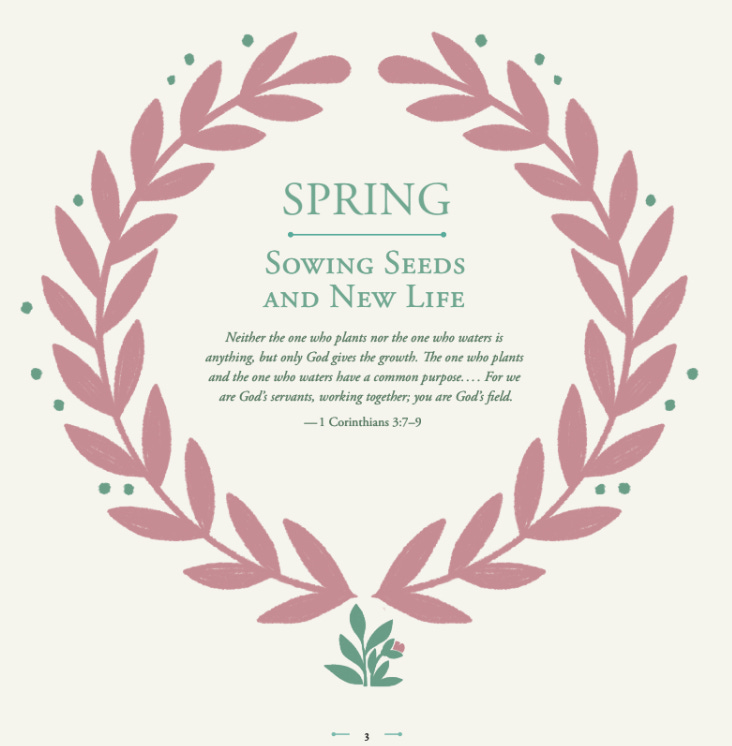
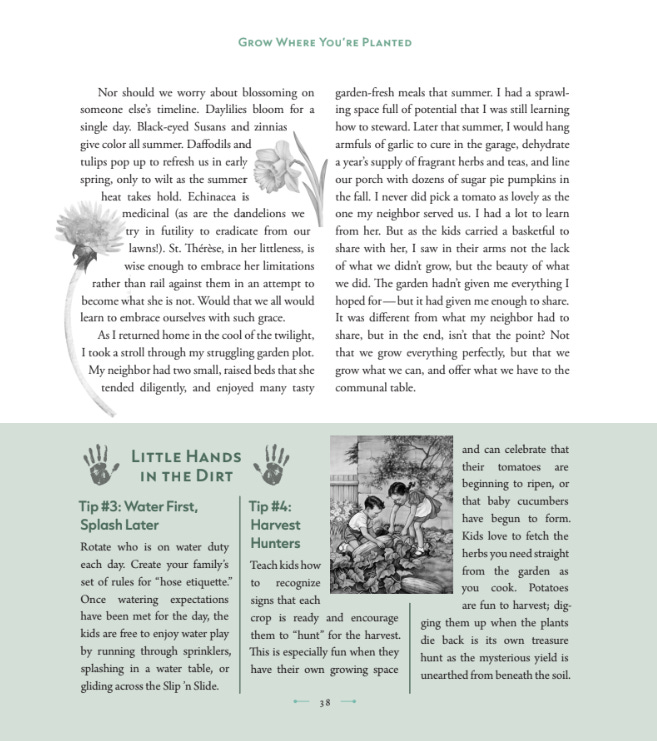
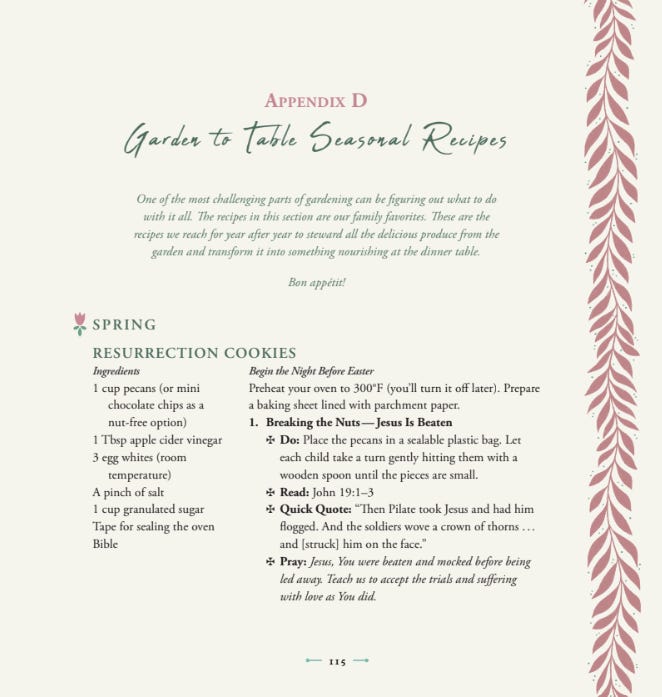
The best part is that you don’t have to wait for the book to arrive to get started. When you preorder, you can preview the downloadable files instantly.
Instant Downloads, Incredible Value
No need to wait: when you preorder, you receive INSTANT access to the following downloads:
a list of my favorite nontoxic products
a month-by month chore guide for cultivating the garden
annual seed inventory
seasonally-inspired garden-to-table recipes
PDF Elementary Science Curriculum with hands-on garden activities, beautiful nature book suggestions for cozy reading, and even a schedule of “TV school” for rainy days of popcorn and snuggling on the couch!
Praise for Grow Where You’re Planted
Here are some of the incredibly kind things people are saying:
Both deeply insightful and wildly practical, this book is gold. Connecting the realities of gardening with the spiritual life isn’t a new take, but not once did I feel I was reading fluffy, heard-that-before ideas. Stephenson is also mindful not to overwhelm as she inspires (and wow does she inspire).
As someone who longs to resist the siren call of the internet and fully be where I am, Grow Where You’re Planted was thoroughly resonant. I recommend it with my whole heart.
— Amber Adrian, One Tired Mother
The Christian tradition is replete with stories, imagery, and parables from earthy realities. In Grow Where You’re Planted, we are given a two-fold view of both physical and spiritual truths as they are gently placed in parallel. Becoming acquainted with the practical work of the ground, we plumb the human heart.
Hands in the dirt become tools for contemplation. Here is a clear-eyed look at how, like what grows from the soil, we can be transformed—both given and giving life.
— Haley Baumeister , Life Considered
Grow Where You’re Planted is a wonderfully practical guide, both for the physical realm of the garden and the spiritual life of the soul. This book is a beautiful reminder that any person can experience an abundant harvest in their own lives. Stephenson’s well-earned wisdom in matters pertaining to the garden and to the soul is truly a treasure trove for readers to discover.
— Cecilia Blackwell, Missionary of Beauty
In Grow Where You’re Planted, Samantha Stephenson has created a vibrant, engaging vision of what it means to intertwine faith, family life, and gardening. She offers meditations on tending both the growth of the Catholic faith and the growth of a family garden. Readers will enjoy her clear and thoughtful directions and meditations.
A book which reveals the garden as a place our divine design is meant to interact with, and where our innate limits are revealed and our innate gifts are of great use. Intelligently ordered by season, philosophical faith-centered considerations for the soul are paired with actionable and practical knowledge for the gardener.
Samantha’s focus on the self discipline she cultivated through the management of her autoimmune disease and how that same sort of discipline can help one access the wholeness which is meant for us via cultivation of our own food is such a honest and hopeful message.
A true call to become literally and figuratively grounded, with our hands buried in the earth and hearts open to whatever may come from our toil, Grow Where You Are Planted is a gardening book for everyone, much like as Stephenson aptly states, “we are all made for the garden.”
— Emily A. Hancock Hancock, mother, nurse, and writer at the Women’s Work Substack
In Grow Where You’re Planted: Reclaiming Eden in Your Own Backyard, Stephenson highlights the unique bond between mankind and the garden. She reminds us that nourishment from the soil feeds both body and soul through pages filled with practical tips and thoughtful meditations.
— Emily Malloy, author Theology of Home IV: Arranging the Seasons
Samantha Stephenson offers a practical and personal guide for cultivating the garden in one’s own backyard—an apt metaphor and prescription for the crisis of the modern family. Her timeless vision of fruitfulness has that rare quality of informing and inspiring without pretense.
Give this book to the people you love.
Bursting with rich spiritual and practical wisdom, Grow Where You’re Planted is an inviting and encouraging read for both gardeners and spiritual seekers alike. Grounded in Scripture and time-tested personal experience, the profound insights and detailed tips found in these pages are worthy of revisiting season after season.
— Catherine Anne Sullivan, Wonder & Awe
It is altogether too easy to forget that we were created for a garden, but it was in a garden that God fashioned man from the very soil. And yet, it seems that we wander farther and farther from that primordial idyll for which we were made. There are those who propose radical returns to the land, but in this age in which many of us find ourselves caught between the pull to return to the garden and the reality of life in the city or in the suburbs, what we need is a guide on how to gently return to fertile ground, both spiritually and physically.
Samantha N. Stephenson’s Grow Where You’re Planted is that guide. Replete with the age-old wisdom and practical knowledge of nature that many of us have lost, Samantha correlates the natural rhythms of the land with the movements of the heart and spirit. I can give no higher praise of her book than this: it has made me yearn to spend my days outside, praying as I work in my garden.
— Liturgy in the Home with Maria
If you know someone who would delight in this book, would you share this post and help get this book into the hands of readers who love it?
Ooh, I know what book I’m requesting for my birthday!
This is beautiful!! I am looking forward to reading your book!