

If you type the words “Mother’s Day gift” into Amazon, you’ll see a lot of customizable coffee mugs and blankets. Maybe a funny candle, soft blankets, or bath salts. And any of those might be the perfect gift for your mom.
But wouldn’t the word be better if we could give gifts that actually nourish people?
Not just entertain them for a few minutes. Not just add to the pile of things already cluttering the house. But genuinely strengthen them in their vocation and interior life?
Motherhood today can feel strangely disorienting. We are surrounded by more conveniences than ever before, and yet so many women I know feel spiritually depleted, intellectually isolated, physically overwhelmed, and longing for something deeper than productivity hacks and self-care slogans.
I think part of the reason is that contemporary culture has become profoundly uncomfortable with dependence, limits, rootedness, and the body itself—all the very things motherhood forces us to encounter daily.
To mother another human being is to live constantly in the reality of creatureliness. You cannot fully optimize it. You cannot entirely control it. Love keeps interrupting your plans. The vulnerable keep making claims on you. Your body matters. Time matters. Presence matters.
And despite what our culture often suggests, I do not think this makes motherhood smaller than other work. Instead, motherhood reveals something essential about what it means to be human.
That conviction sits underneath every book I’ve written, even the ones that look very different on the surface.
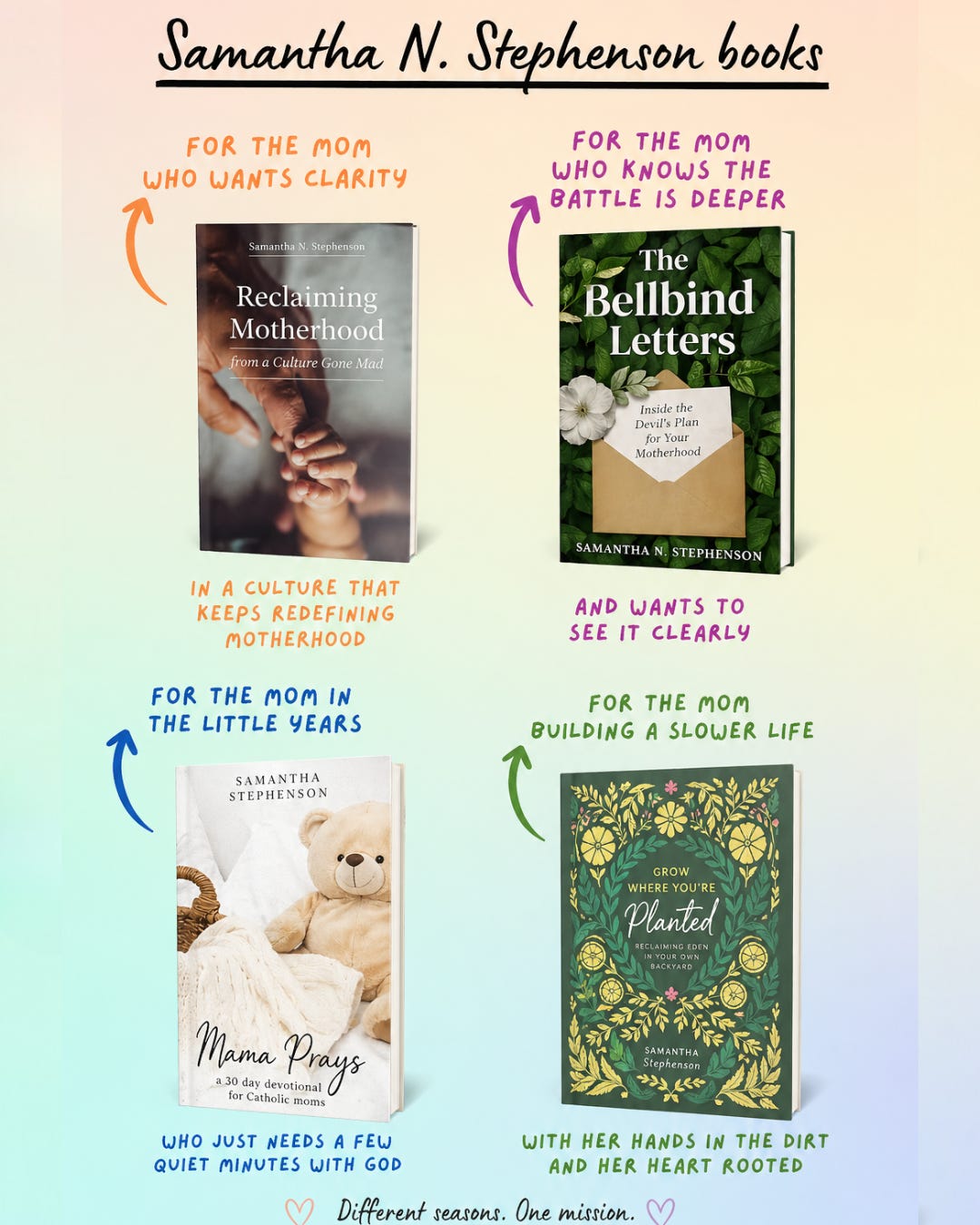
So if you are still looking for a meaningful Mother’s Day gift, I thought I’d share a few of them here. Each is a companion for a different season of motherhood and spiritual life.

The Bellbind Letters exists because I have always loved The Screwtape Letters and have long thought mothers needed something similar written particularly for them—and written from a distinctly Catholic imagination.
Lewis was brilliant at exposing spiritual warfare through satire. He understood that evil often works not through dramatic wickedness, but through distraction, distortion, confusion, vanity, comfort, and small compromises accumulated slowly over time.
But I increasingly found myself wanting a version that wrestled more directly with the particular spiritual pressures facing mothers and families now.
The contemporary world places extraordinary strain on attention, embodiment, family life, and even our understanding of what it means to be human. And mothers stand very near the center of that battle because mothers remain guardians of things our culture often undervalues: dependence, vulnerability, continuity, memory, incarnation, and home.
So The Bellbind Letters became my attempt to explore spiritual warfare in an age of biotechnology, digital immersion, disembodiment, and endless distraction—but through a deeply Catholic lens.
Not merely “Christian morality” in the abstract, but a deeply sacramental vision of reality. One where bodies matter, meals matter, birth matters, ritual matters, and grace enters the world through physical things. A world where the home is not spiritually insignificant, motherhood is not peripheral to civilization, and the battle for the family is not merely political, but profoundly spiritual.
(Author’s note: I was also particularly pleased with the prose and amazed by the alliteration I was able to include on this one.)

Grow Where You’re Planted is a practical gardening guide filled with spiritual reflections that were born in the garden with my hands in the dirt.
Contemporary life trains us to live as though we are disembodied minds floating above creation. We spend enormous amounts of time in artificial environments, mediated through screens, detached from seasons, weather, soil, limits, and dependence on God’s provision.
Gardening interrupts that illusion.
You cannot force growth. You cannot control the weather. You cannot rush a season God designed to unfold slowly.
Grow Where You’re Planted is ultimately a book about recovering wonder in ordinary life and learning to receive our limits not as punishments, but as invitations into communion with God, creation, and one another.
And perhaps that is one of the great callings of mothers in this cultural moment: not merely to consume the world as it is, but to cultivate places where life can still take root and flourish.

We are living through a moment where nearly every limit of the human person is being reframed as a problem to overcome. Fertility becomes a burden. Aging becomes a defect. Dependence becomes humiliation. The body becomes raw material for self-creation rather than something received with meaning and purpose.
And mothers experience the pressure of those ideas very intensely because motherhood ties us so concretely to reality, biology, time and vulnerability.
We are sold the lie that “happily ever after” is synonymous with a life of pleasure and ease, when, in truth, it is just the opposite: true love demands sacrifice rather than self-optimization.
I wanted to write a book that helped women see that their discomfort with modern motherhood narratives was not irrational or reactionary. Much of what we call “progress” has come with enormous spiritual and cultural costs, particularly for family life.
But I also did not want to write a nostalgic manifesto pretending the past was perfect. My hope was to recover a richer and more humane vision of motherhood—one rooted in the Christian understanding of the person as embodied, relational, and created for communion. That vision—the vision the Church has articulated for 2,000 years—is exactly the vision presented in Reclaiming Motherhood, ancient wisdom applied to our temporal moment. (These are in short supply on Amazon, but if you don’t mind a shipping delay, you can order signed copies directly from me by replying to this email).

I wrote Mama Prays during a season when my spiritual life felt very small by the standards I once imagined mattered.
My prayer was interrupted constantly. I was tired all the time. I rarely finished a spiritual book. Silence was hard to come by, and even when the house was technically quiet, my mind often wasn’t.
I think many mothers quietly carry the fear that they are failing spiritually because their lives no longer resemble the conditions where contemplation seems easiest. But motherhood has increasingly convinced me that God is not waiting for us somewhere outside ordinary life. He is here, in the hiddenness of it.
In the laundry room. At the kitchen sink. In the rocking chair at 2 a.m.
The vocation of motherhood forces us into dependence in a way our culture deeply resists. It confronts us with our limits, our neediness, our inability to control outcomes. And yet Christianity begins precisely there—not in self-sufficiency, but in surrender.
So this devotional was never meant to be impressive. It was meant to accompany women trying to remain rooted in prayer while living very embodied, interrupted lives.
PS If you loved any of these books, please please leave an Amazon review! They help authors (and readers) so, so much.
I’d love to ask for your prayers as I travel to Alabama next week to film at EWTN studios.
I think it is no coincidence that my first taping there was October 13, the day the sun danced, and I will be back to film the next two episodes on May 13, the Feast of Our Lady of Fatima. Sr. Lucia, Fatima visionary, revealed that the final battle will be over marriage and the family. Mothers are the heart of the home, and therefore central to that battle.
Our Lady of Fatima, pray for us!
I will send links to the episodes when they become available.
And speaking of links, here are my latest interviews if you’re interested:
Salt and Light Radio Review: not an interview, but a rave review of Grow Where You’re Planted that gives a fantastic look inside the book and does a great job highlighting the various features and extras—which are many, in case you’re on the fence ;)
And here are links to the last few episodes of Brave New Us for this season. I’ll be quietly working on some exciting new projects this summer, very behind-the-scenes work (which is actually my favorite way to work).
I can’t wait to share the news with you when the time comes. For now, please enjoy the fantastic interviews that wrapped this season:
Made Good: Making Peace with the Body with a Catholic Nutritionist (this book also makes an amazing Mother’s Day gift!
Your Uterus or Mine? How Transplantation is Changing the Face of Reproductive Medicine
Touching Grass (a preview of my audiobook, which is narrated by yours truly)
Finally, this quote from the Vatican is my most loved Note here on Substack EVER. Definitely worth resharing here:
It may or may not be central to that project I’ll be working on this summer ;)
AMDG,
Samantha