
Can You Homestead on a Third of an Acre?
Rethinking Self-Sufficiency in Suburban America

When we began cultivating our typical suburban backyard, I kept asking myself one question:
Could we really make a third of an acre feed a family?
On the surface, it seemed impossible—but what we discovered changed everything about how I think about food, space, and stewardship.
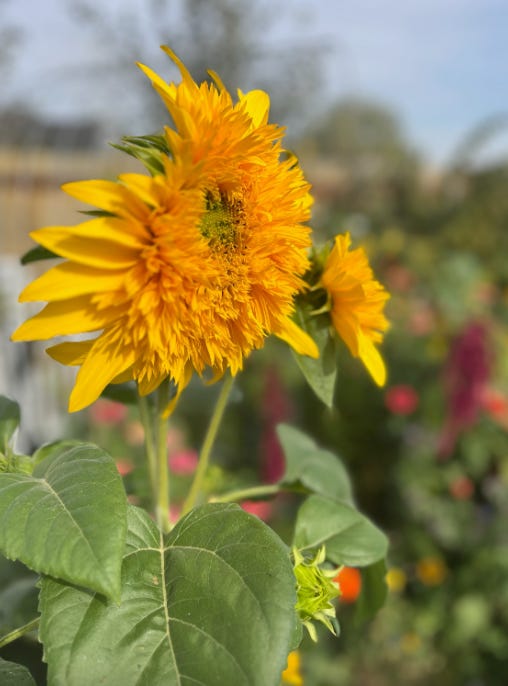
On the one hand, a third acre can’t supply us with beef, dairy, or grains that we need to feed our family. The more I lean into this lifestyle, the more I learn to provide for our family with what we’ve been blessed with—the more I believe the goal isn’t really self-sufficiency. Not entirely. It’s interdependence with a like-minded community of those who believe that all of this—the growing, the preserving, the handmade life over the instantaneous one—is worth the effort.
I can’t raise my own cows, but I can purchase beef in bulk from someone who raises them like I would. I can make our family’s yogurt with raw organic A2 milk from a dairy just miles down the road. I can grow an abundance of berries and watch as my children bite in and let the juices run down their chins in hot summer sun.
“Can we call this a homestead?” I kept asking myself.
Our little piece of land in cookie cutter suburbia sure doesn’t look anything like what one pictures when you hear the word “homestead.” Some people say it isn’t right to call this a homestead, and I go back and forth on that myself.
At the end of the day, for me, it all comes down to mindset. When you make the commitment to become your own food source, to learn long lost skills, every tomato grown and berry pie baked becomes something intangibly satisfying.
Yes, it is as much work as it sounds. More, probably.
“Why do you do it?” people ask. “Is it worth it?”
God didn’t put us on this earth for a life of leisure. Sunday rest, yes, but rest from fully extending ourselves in imitation of our creator who actively labors in all of creation.
When we create, we act in His image. When we grow our food, we take on the stewardship he has given us. I love caring for our soil, for the pollinators on our patch of Earth.
We are to grow where we’re planted and be good stewards of what God has given us, to be faithful in the small things. For those who can be trusted with what is little will be trustworthy with still more.
We do what we can. Every journey begins with a single step.
Our first year growing in this space, I got just shy of a year’s worth of potatoes and more squashes than we could eat. The following year I got six months of onions. The potatoes were small, and washing the dirt off to prepare them for supper was more labor than I was used to.
This year we added garlic to our storage crops, and I’m amazed by how crisp and flavorful it is straight out of the garden.
Progress is slow, but with every harvest we are gathering not just food, but reaping the benefits of all our hard work, painful lessons, and experiencing the freedom of producing a bounty with our own hands.
After you try to grow your own food, it becomes impossible to be ungrateful for the abundance we do have. I honestly look back to all those years that I just had no idea what it takes to sustain a family, and I’m amazed at how far we have really come.
In this time, we have big plans, lots of projects coming up to showcase how to be creative with the space you have.
If you enjoy this, I’d love if you would share it with someone. I think we all struggle with these limiting beliefs, and it just comes down to giving it a leap of faith, no matter how small a space we’re given.
Everyone can grow where they’re planted, and we all benefit from greater knowledge of these skills, of really caring for ourselves and the needs of our family that used to be so common.
If you’re curious to see this process in action, our YouTube channel shows how we transform a small suburban backyard into a productive, thriving homestead. Watching it come to life has been one of the most inspiring parts of this journey, and I’d love to share that with you.

Of course, all of this isn’t just about our family. If it were, there would be no need to share what this looks like on YouTube or to write it all down in a book.
Ultimately, I hope families’ eyes might be opened to the wondrous possibilities in their own soil, yards, and back porches. That’s why I wrote Grow Where You’re Planted: so that we all can become better stewards of what we have, and to participate more fully in the miracle of creation. In this book, I break down step-by-step how families can turn whatever space they have—whether a small suburban yard or even a corner of their patio—into a space that spills over with seasonal abundance
I’ve already heard from many of you who have purchased the book, and I am dying to see pictures of all of your gardens this year!
Wouldn’t that be amazing, to fill up our screens this summer with the fruits of our labor, to inspire others to get outside, to touch grass, and revel in the magic that happens when we plant seeds in the soil?
Here’s to becoming better stewards of what we have, and learning to grow wherever we are planted.
AMDG,
Samantha
We have moved from 25 acres to now living on just 1/4 acre it's a shift and we are planning our new food backyard bringing laying hens, meat birds, meat rabbits and such to our little space. Basically a long way to say this resonates and glad I found you
We have a postage stamp for a yard, but I desperately want to build a few garden boxes and try to grow a few things. It might not happen this year since I’m already growing a little one due this summer, but I definitely need to get at least a few potted plants to test the waters.