

My husband and I are a complementary fit, but—in many ways—polar opposites. He takes risks. I avoid them. He thinks F1 racing looks exhilarating and fun. I see it as a potential manifestation of my own personal purgatory. He loves the thrill of a roller coaster, and I like to keep my feet firmly planted. He skips to the movie; I am adamant that I must first read the book.
So it comes as no surprise that when it comes to new technologies, he is a first adopter, and I border on Amish (unless that technology is a robot vacuum, in which case I say, “Beam me up!”).
Given this context, our attitudes towards AI are pretty predictable: while I have been glaring warily at the apocalyptic Beast come to devour all human creativity, my husband has busied himself building an AI chatbot. For Fun. (In his defense, he works in tech, and his job is literally to be the top guys managing his company’s AI rollout. Perhaps this was inevitable.)1
In their spare time, my husband and another faithful Catholic father have developed Chatechism, a 100% Magisterially Catholic, truth-telling answer machine.
On the one hand, what they’ve developed is impressive. I am a little in awe, having witnessed the whole process of development. I’ve done my best to “break” it, to get it to spit out heretical answers, and to have it prove my distaste for AI in general well-founded.
All I can say is that—for a lifeless robot—it knows its stuff.
Do I think it’s awesome and incredibly cool?
Yes.
Is it better than its competitors Truthly and Magisterium AI (which I never would have set eyes on save for the fact that I am a biblically-based wife putting myself under the mission of my husband)?
100%.
If it were up to me, would I still choose a world without AI?
You bet.
The thing is, though: it isn’t up to me. And if God allows AI, God will redeem the existence of AI. Tenfold. A hundredfold. And I firmly believe that Chatechism (totally the best name of the three—by far—don’t you think?) is one of the concrete ways God is redeeming AI.
Here’s why I think Chatechism is such a gift for the Church today:
Makes the faith accessible—for people exploring Catholicism, for those in revival, and for anyone curious about conversion.
Gives users a reliable way to ask the questions they might not feel comfortable asking out loud.
Each answer comes with a “Fide Score,” showing how closely it aligns with Church teaching—so users can trust it while still thinking critically.
Sources are listed right there, which is amazing for study, research, or just satisfying curiosity.
Always points back to human connection—to priests, spiritual directors, and the wider Body of Christ—because AI can’t replace the guidance and companionship of real people.
Lets users explore the faith through different personas with unique answers: Thomas Aquinas for theology, a spiritual director for guidance, and a catechist for teaching clarity.
Helps the Church share the faith in a way that’s approachable, thoughtful, and rooted in real relationships in the digital age.
As disciples of Christ, we are called to spread the gospel to the ends of the earth. That means baptizing even—or perhaps especially—these globalized, digital spaces.
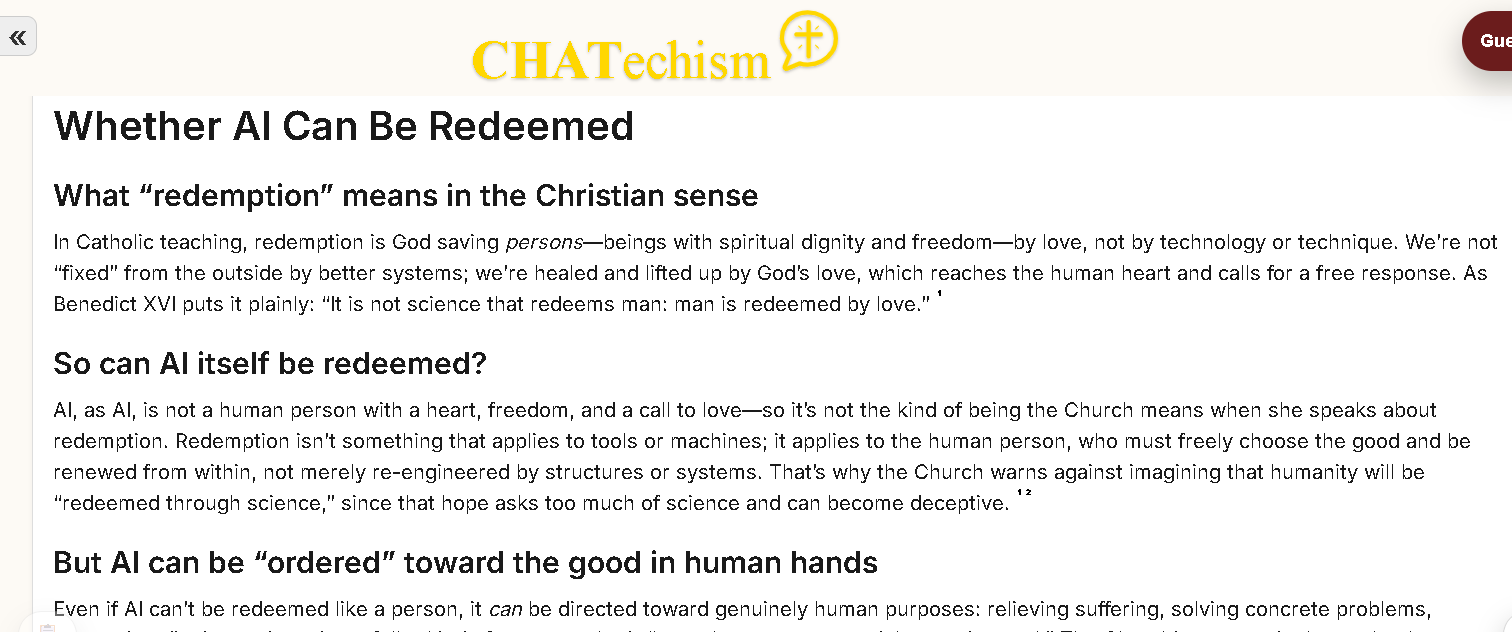
I’ll keep saying it: we were made for such a time as this, and this is the ground on which our fiat takes form. As much as I’d prefer to be an ostrich with my head buried firmly in the sand, I have to admit that my husband is making the right call on this one. If Christians don’t actively shape this technology from the outset, who will? What values will direct what it becomes—what we become?
That’s part of why I’m so excited about Chatechism. It’s absolutely a clever AI tool, but what makes it transformative is the harnessing of new technology to bring the faith into digital spaces thoughtfully, faithfully, and in a way that invites people to encounter the Church and the Body of Christ. By giving answers rooted in the Magisterium, pointing users toward human guidance, and helping people explore questions they might never ask out loud, it shows how technology can serve evangelization rather than replace it.
At the end of the day, I have faith in God’s promise that in all things—even AI—He works for the good of those who love Him (Romans 8:28).
(Of course, that doesn’t mean I’m not grateful to be an eye and not a hand, if you know what I mean…)
AMDG,
Samantha

The Princess Bride (book, not movie) was formative in the use of parenthetical notations in this post. If they bother you, blame William Golding. And if you, like my husband, skipped the book, stop reading this post and remedy that immediately.